 |
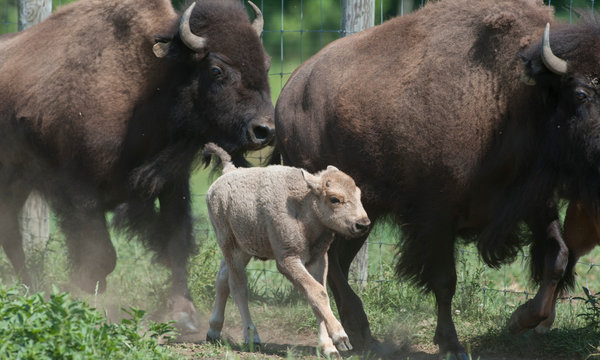
| A white bison at the farm of Peter Fay in Goshen, Conn. The birth of the bull calf a month ago drew attention from some as an auspicious event. |
Very, very exciting news indeed! I feel as though this creature
has not only been born, it has returned to the once-sacred land of the Native
American tribes of Connecticut (Quinnehtukqut). It is a great moment on the planet as the
bison calf is a highly auspicious omen. We were promised that they would
come back, and here is wonderful proof of prophecy fulfilled! And I am
personally proud because I am from Connecticut, so this event takes on a deeper
meaning for me. Additionally, in a prescient move by lawmakers, "Less than a month before this bison
was born, the National Bison Legacy Act was introduced in the Senate. The act
would designate the American bison as the 'National Mammal of the United
States.' It has 15 co-sponsors,
including the two senators from Connecticut..." This is a sweet, sweet moment and one I hope will
reverberate with joy and light for our nation and the rest of the world. -S.C.-
Thanks to Marilyn
Thanks to Marilyn
A Bison So Rare It’s Sacred
by Peter Applebome for nytimes.com
GOSHEN, Conn. — If one were asked to pick a typical home where the
buffalo roam, the answer probably would not be Litchfield County amid the
rolling hills and understated rural chic of Northwest Connecticut.
But when Bison No. 7 on Peter
Fay’s farm gave birth to a white, 30-pound bull calf a month ago, it made the
Fay farm below Mohawk Mountain, for the moment at least, the unlikely epicenter
of the bison universe.
For Mr. Fay, what happened was an
astoundingly unexpected oddity — white bison are so rare that each birth is
viewed as akin to a historic event.
For Marian White Mouse of Wanblee,
S.D., and other American Indians, it is a supremely auspicious message from the
spirits. She will fly with her family to Connecticut for naming ceremonies at
the end of the month that are expected to draw large crowds.
And for those to whom the bison is
an iconic part of the American experience, the birth is, at the least, a
remarkable coincidence, coming at a time that wildlife, tribal and producer
groups are lobbying Congress to have the bison officially designated as the
national mammal and a national symbol alongside the bald eagle. (The words
buffalo and bison are often used interchangeably, but the North American
version is properly called bison and its distant cousins in Asia and Africa are
buffaloes).
Mr. Fay, who has an elaborate bison
tattoo on his right shoulder and another above his heart, comes from four
generations of dairy farmers and makes his living through an excavating and
rock-crushing business. He began raising bison as a hobby four years ago,
capitalizing on a growing appetite for bison as a leaner alternative to beef,
and then became increasingly excited about the animals, building his herd to
more than 40 until he sold off about half of them two months ago.
“They’re awesome animals, wild, not
domesticated,” Mr. Fay said. “You think of them in South Dakota, where it’s a
desert and hot in the summer and bitterly cold in the winter. They don’t mind
either one. And they don’t get sick. They’re not like a cow. They’re very
hardy. They can deal with anything.”
Mr. Fay, 53, said he was watching a
female preparing to give birth on June 16 when he realized a second one was
about to give birth as well.
